





From Batman to Basquiat
Street legends, museum caliber Artists,
Two Women Gallerists in Tribeca.
The story behind the Frame of MaryAnn Giella McCulloh and Mei Fung and One Art Space One Art Space on Warren Street in Tribeca sits at street level behind a glass façade, bright enough in the afternoon that you can read the room in a single glance: walls alive with color, a clean openness to the floor, the sense that whatever is happening inside is meant to be shared.
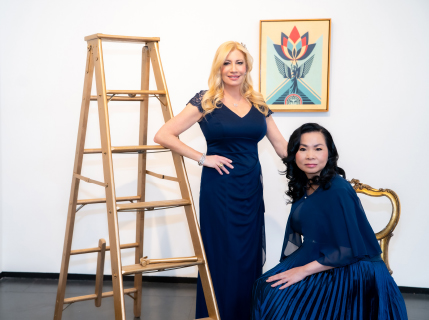
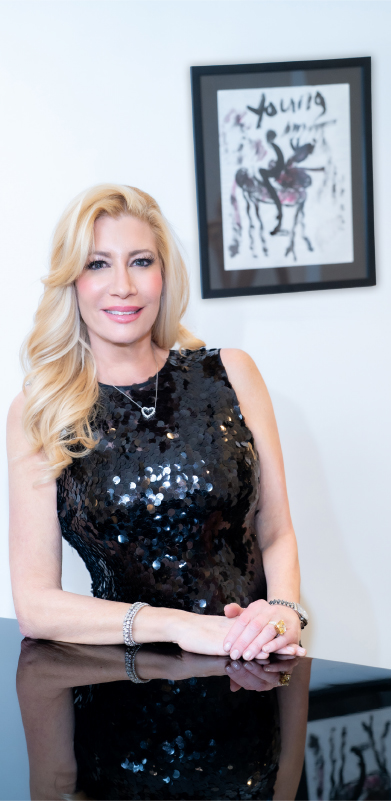
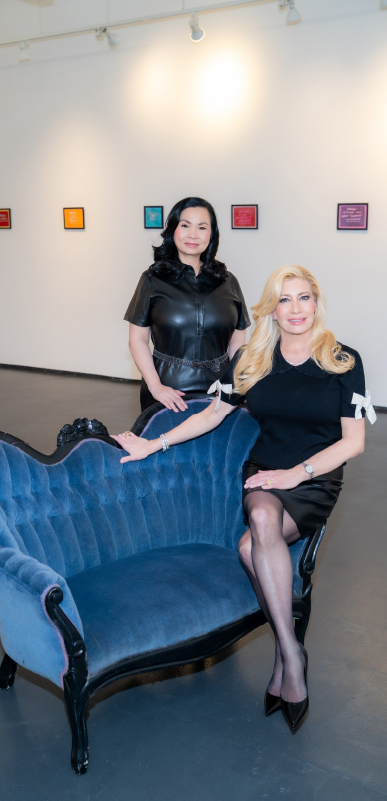
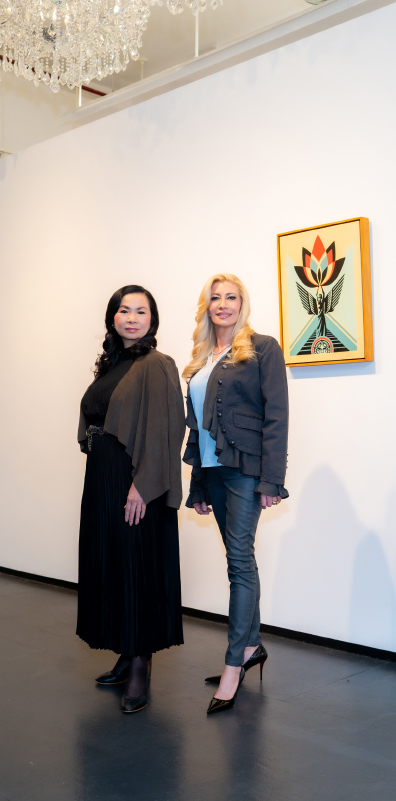
That atmosphere, the sense that art should be part of regular life, is the result of how the gallery is run now: by co-owners MaryAnn Giella McCulloh and Mei Fung, who stepped into the center of the story after the passing of Dan Giella, the gallery’s founder.
The arc that connects them is personal. It is also very New York: family, hustle, reinvention, and the stubborn belief that culture should not be reserved for people with the right vocabulary.
And it begins, oddly enough, with superheroes.
Before MaryAnn Giella McCulloh was negotiating exhibition schedules with artists and meeting collectors, she grew up around drawing as a daily practice. Her father, Joe Giella, who was hire by Stan Lee, who was one of the original Batman comic illustrators, part of a generation of artists who defined the look of American pop culture.
Decades later, Joe Giella’s work was recognized in 2006, the U.S. Postal Service released a DC Comics Superheroes stamp set that included images featuring his inking, including the cover of Green Lantern and The Flash. It was the kind of full circle moment that speaks to the Giella family’s particular place in American visual culture: art that traveled far beyond the studio and into the public’s hands.
MaryAnn talks about that upbringing as a training in range. They are different forms of storytelling, both capable of craft, emotion and resonance.
Dan Giella took that same instinct and applied it to the contemporary art world. Dan was the original founder of One Art Space and gave it a straightforward purpose: show strong work, support artists, and keep the door open wide enough that the experience did not feel like a private club.
One Art Space has occupied a corner of downtown Manhattan since May 2011, offering a ground level gallery with natural light and an inviting view from the street. The space is about 1,700 square feet, intimate by New York standards and big enough to host a crowd without swallowing it. On busy nights, the room becomes a kind of downtown civic square, where collectors and first-time buyers, artists and neighbors, critics and the casually curious end up shoulder to shoulder, talking through what they see.
Dan’s career moved between creative disciplines. He was a graduate of the School of Visual Arts, and he worked across design and art direction before building a gallery. Friends and artists around One Art Space still tell a specific story about him: that he opened doors early and often, giving artists their first serious opportunities, introducing them to collectors, and treating their careers as worth the risk.
One of the projects he was proudest of, MaryAnn says, was creating an official New York City Marathon poster that visually brought the five boroughs together in a single image, a design job that doubled as a civic statement. Another was designing holiday cards for Meals on Wheels, a reminder that art is not only about galleries and sales but also about service.
Mei worked closely with Dan Giella, the founder of One Art Space, both at the gallery and as his longtime partner. For eight years, Mei supported Dan and helped sustain the gallery as he endured a prolonged illness, becoming a constant and compassionate presence - truly an agnel to him.
MaryAnn Giella McCulloh, whose professional life had been built in high level corporate sales, stepped forward in a way to preserve and protect Dan’s legacy and vision and the culture of the gallery intimately, became the person responsible for its future.
MaryAnn’s path to the gallery’s front line did not begin in the art world’s traditional channels. She built a career in executive level sales and management, including long stretches on the Northeast corridor managing large regional territories, building training systems and sales manuals, and taking on the kind of corporate pressure that teaches you how to close, how to negotiate, and how to lead.
She also spent time as an independent logistics broker, handling million-dollar relationships, the sort of work she jokes was better than making other companies’ money because it finally made sense on her own terms.
Those details matter because they explain what changed after Dan’s passing. One Art Space did not become a different gallery. It became a gallery with a new kind of operating muscle.
Today, MaryAnn describes the job in the language of total immersion: full time, all the time. The gallery is not a side pursuit. It is a life. She has used her sales background to pull museum caliber and blue-chip names into a street level Tribeca space, while also keeping the gallery’s founding tone intact: accessible, conversation forward, and community minded.
If MaryAnn Giella McCulloh brings outward energy, deal making and visibility, Mei Fung brings steadiness and continuity. She worked closely with Dan as the gallery grew and has remained committed to his central idea: art should be approachable and community driven.
MaryAnn calls their partnership a yin and yang, opposite forces that create a dynamic bond. It is an image that lands because it describes what visitors actually feel: the gallery’s ability to be both welcoming and serious, both energetic and calm, both street level and museum aware.
Together, they have turned One Art Space into a place that can move comfortably between worlds: international contemporary artists such as Andrew Salgado, A Canadian-British contemporary artist based in London, Andrew Salgado is known for his large-scale, emotionally charged figurative paintings. His numerous sold-out exhibitions at One Art Space showcased his signature blend of portraiture, abstraction, symbolism, and richly textured surfaces—vibrant, layered and shared his exhibition with audiences that include collectors, critics, and people walking in off the sidewalk.
The gallery built its reputation on one thing: backing women artists before the rest of the world caught up. Its international women’s exhibitions became so in demand they broke their own format—expanding into multiple shows to keep pace with the talent. Now running proudly for eight and ten consecutive years, these annual exhibitions don’t follow trends; they set them, placing bold, globally minded women artists exactly where they belong—at the center of the conversation.
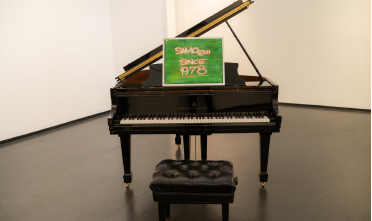
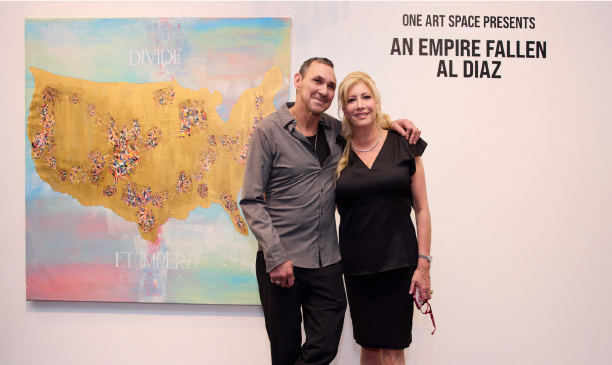
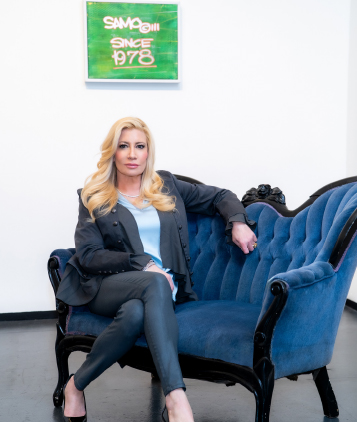
In October, One Art Space opened a solo show that reads like a statement of intent: “An Empire Fallen,” by Al Diaz. Diaz is not simply a contemporary artist. He is part of the DNA of downtown New York. A first-generation subway graffiti artist, he gained lasting recognition through SAMO, the cryptic street poetry collaboration with Jean Michel Basquiat that helped define the late 1970s avant garde moment. In “An Empire Fallen,” Diaz explored the collapse and reinvention of cultural empires through text, symbol and social commentary, pushing the viewer to confront how power, consumerism and history press against the present day.
MaryAnn Giella McCulloh frames Diaz as the kind of artist One Art Space was built to champion: “He embodies what One Art Space stands for, artists whose work tells the story of this city and its uncompromising creative spirit,” she says.
In November, One Art Space presented “Thread of Memory: The Language of Healing,” a solo exhibition by Korean artist Sung Min Jang, with a private VIP reception. The show explored memory as something fractured and layered, reconstructed through meditative textures, textile motifs and symbolic “threads.” MaryAnn calls the work “quiet but emotionally seismic,” and she emphasizes why it belongs at One Art Space: it connects people across cultures and lived experience without requiring an insider’s guide.
Taken together, the two exhibitions say something about the gallery’s curatorial identity under MaryAnn and Mei: it is not one aesthetic, but one standard. Art that carries a story. Art that asks something of you. Art that stays with you when you leave.
There is another name that repeatedly anchors that standard: Shepard Fairey. One Art Space has shown and supported street art’s most recognizable voices, and MaryAnn does not hesitate when asked who defines the category in America. For MaryAnn and Mei, Shepard Fairey is a champion of the gallery and, in their view, the leading street artist in the United States, best known for the iconic Obama HOPE 2008 Campaign Poster and legendary André the Giant.
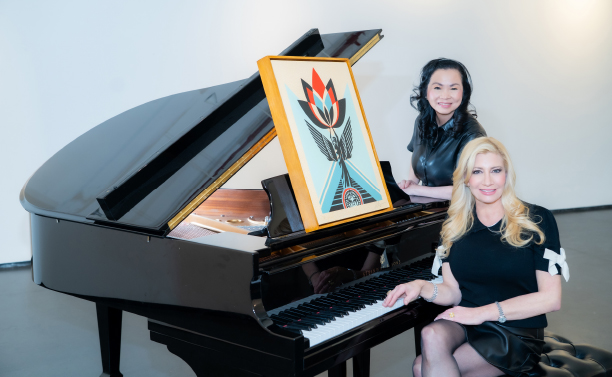
Fairey’s work has long fused street level graphic impact with activism and design. At One Art Space, the relationship is not just about a famous name on the wall. It is about alignment. Fairey personally selected the “Lotus Angel” for the gallery, a symbol of hope, compassion and resilience that has become a touchstone for what the space tries to hold: seriousness without elitism, accessibility without dilution.
That idea, that a piece of art can function as a kind of moral emblem, sits neatly alongside MaryAnn’s own way of describing her curatorial instincts. “Art should be felt, not just seen,” she says. “At One Art Space, we want people to walk in and feel part of the story.”
By January, the program returns to another core value: community as practice. That month, One Art Space hosted “The Space Between Us,” a group exhibition curated by New York City based artist Mitchell Rodbell, bringing together 13 artists from The Art Students League, along with Board member, in a week-long presentation that explored connection, contrast and the emotional charge that lives in shared spaces. The reception included a VIP hour followed by a public opening, a format the gallery uses repeatedly because it mirrors its broader approach: welcome everyone, while still honoring the realities of the art market.
The winter season culminates with an exhibition designed to land with both cultural weight and emotional clarity: a February 2026 presentation of works by Purvis Young, timed to Black History Month and described by the gallery as including unseen works making their New York debut.
Young’s visual language is direct, compassionate and socially engaged. The exhibition centers on recurring themes of empathy, healing and the possibility of a better future, motif the gallery describes as a symbol of hope. Young’s work is held in major museum collections, including The Metropolitan Museum of Art, the Whitney Museum of American Art and the Smithsonian American Art Museum. A VIP reception is planned for the first week of February, and the show runs through the month.
The programming says a great deal about what MaryAnn Giella McCulloh and Mei Fung has done since Dan’s passing: They have made One Art Space bigger without making it colder in keeping with the mission of the Gallery, to create a place where the giants of art history and the visionaries of art’s future come together in One Art Space.
That mission is not abstract. You can see it in how the gallery links a family legacy of American illustration to a downtown street poetry lineage, how it moves from the historic force of Al Diaz to the meditative repair work of Sung Min Jang, how it presents community-based group shows in January and a Black History Month anchor in February.
MaryAnn Giella McCulloh took the reins at a moment when many galleries would have tightened, narrowed, and tried to protect themselves with exclusivity. Instead, she applied the instincts of a seasoned sales executive to the art world’s most unpredictable variable: people. She built visibility without losing authenticity. She kept the room open. She made sure the work remained strong enough to stand on its own.
Mei Fung held the continuity, honoring Dan Giella’s belief that art should be approachable, that community is not an accessory to the gallery but its structure.
From Batman to Basquiat is a catchy line, but in New York City it is also a map. It tracks the way images travel through the city: from comic panels to subway walls to museum collections to a glass fronted gallery where anyone can walk in, look up, and feel part of the story.
And in Tribeca, that may be the most contemporary idea of all.
Hair by Marco Maranghello | Makeup by Yli Lirian | Piano Ctsy: Klavierhaus New York | France