

 --
--

Italy’s Emilia Romagna
A Region Rife with Reasons to Visit
Sting, Princess Diana, Frank Sinatra, Prince Albert…They’ve all penned touching letters to Luciano Pavarotti, and their epistles are on display at the welcoming and touching Casa Museo Luciano Pavarotti (the maestro’s last home) in Modena, Italy. Through cream- and snowy-white-colored vellum, the warmth and love these superstar luminaries held for Pavarotti gently course from the written page, softly stroking the viewer’s heart.
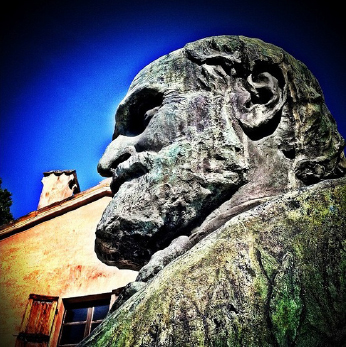
As you read this selection of letters to—arguably—one of the greatest tenors to ever live, tears and tenderness will fill your heart, too. You don’t have to love opera or even know the difference between an aria and an artery, to smile with pleasure at the outpouring of love to, and respect for, the maestro.
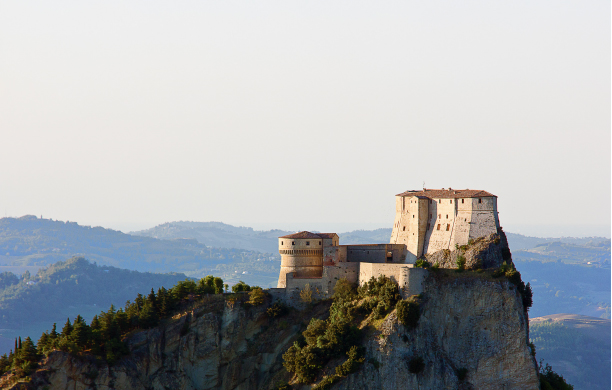
Visiting Casa Pavarotti was but one highlight I experienced during a glorious trip to the Italian Region of Emilia Romagna. Nestled in the upper reaches of Italy, and spanning almost the entire “width” of the country’s boot, the region boasts about 9,000 square miles and a population just under 4.5 million. This administrative division is bordered to the south by the more popular Tuscany, with Lombardy to the north, and the famed Veneto to the northeast. But make no mistake, when you consider your next Italian sojourn, think Emilia Romagna instead of the over-touristed Tuscana and Veneto. I wished I had had more time in the region, as there was so much more to see and do.
With UNESCO World Heritage nods to Parma, Modena, Bologna, Ferrara, and Ravenna, you will not want for sites steeped in history to explore. Acknowledged by foodies all over the globe, Bologna is the culinary capital of Italy. But, on this trip, I had come to hear Verdi, first and foremost. My trip was timed to coincide with the celebrated Verdi Festival in the region. A native of Busseto, Verdi is among a triumvirate of the area’s most recognized musicians: Toscanini was also born here, and, of course, the adored Pavarotti.
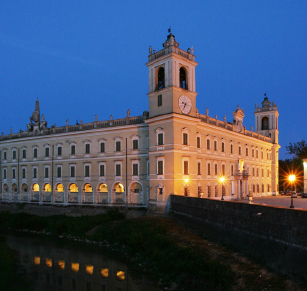
The minute I arrived in Parma on a lazy, sunny Saturday afternoon, I was captivated by the vibe. Le tout Parma was out and about, cafes were overflowing, and the air was redolent with scents of Italia—pasta, espresso, Parmigiano Reggiano, and Prosciutto di Parma ham…you get the idea. As my driver turned onto Borgo Angelo Mazza, the little alleyway that was the “street” where Hotel Torino, my home for a few days, was located, I was immediately drawn to overhead electric signage, strung across the street—side to side, every twenty or thirty feet. Hmm? I realized I was looking at…words! A message! And in these luminous canopies over the cobblestones, were the words of one of Verdi’s most illustrious choruses, Va Pensiero—from the opera Nabucco, in which Italian slaves’ remembrances of their homeland speak directly to Italians who more or less adopted this chorus as a twentieth-century rallying cry in Italian political history. It was so moving…and later at night in the darkness, the lights erupted brilliantly.
I had but two days to absorb as much Verdi as possible, and there were events taking place all over the area—in some of the most storied palazzos and museums. Concerts, lectures, panels, intimate recitals, and so on. But the highlight of my stay was a performance in the Teatro Regio Parma, an old-fashioned, oozing-with-ormolu opera house, seating 1,400. Verdi’s MacBeth never sounded so good!
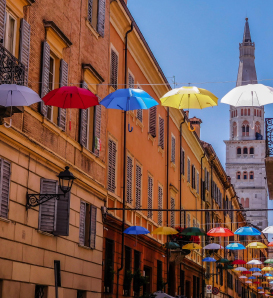
Next, Modena, a short train ride away, where I explored the city on foot. Depending on how much you want to see, allow for two-three days here. Do not miss the Ducal Palace, the Cathedral and the Ghirlandina, Town Hall, and the Synagogue. Grab lunch in the covered Mercato Albinelli, where you will wonder just how many ways can a cheese monger make and sell gorgonzola or ricotta?
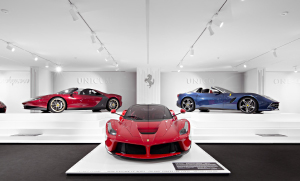
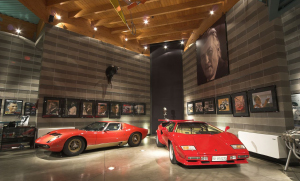
With Modena as a base, I took in what is referred to as Motor Valley, which Ferrari, Lamborghini, and Maserati call home. You can easily spend a few hours in the Ferrari Museum alone, but allow time to explore the famed “factories” were balsamic is made, as this is where the renowned aceto balsamico tradizionale is produced and tasting them will lure you to a stop outside the city proper to an acetaia, or balsamic-production house. These are usually small, family-run operations, where balsamics can age for 25 years or even longer. I chose Acetaia Villa San Donnino, where the finest balsamic was jet-black, thick like molasses, and tasty beyond words…perfectly sweet or tangy or powerfully layered with flavors you cannot even define. The prices, however, are easily defined—in a word, pricey; they can readily soar to well over a hundred euros, for a bottle with what you might define as not much more than a smidgeon or two. That price tag is a testament to the difference in quality between run-of-the-mill balsamic at your local supermarket and this extraordinary ambrosia; it is an absolute must to bring some home.
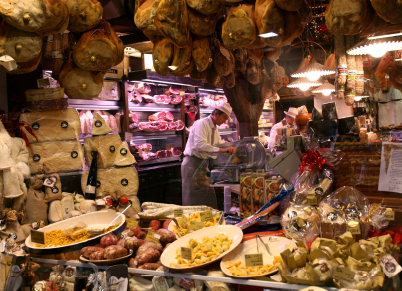
Bologna, the capital and largest city in the region, is known for its signature, UNESCO-designated porticoes, which crisscross the city, enriching it with 24 miles of covered walkways, shielding you from the elements, in the historic town center. They are awash with rich mosaics and decorative paintings. I fell in love with this city thirty years ago and was even more enchanted by it this time around.
One of the highlights of my visit this time around was a cooking lesson with the fascinating, effervescent, and talented Cristina Rossi, a member of a loose-knit group of cooking teachers, Cesarine, located all over Italy. Cristina runs a lovely B & B, but also teaches cooking classes in her home—and I must admit, my time with her did not feel like school—it felt as if I were hanging out with a girlfriend, admittedly, one who really knows how to cook!
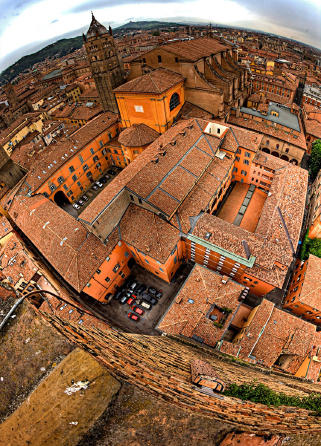
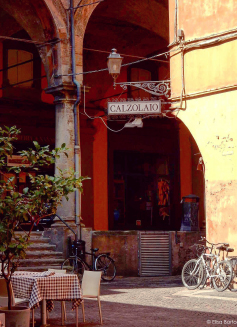
Regardless of what else you do in Bologna, cooking is a must, and then layer over that core experience, all the fabulous sights, churches, the Clock Tower, Piazza Maggiore, Basilica of San Petronio (only half-clad in luscious pink marble), Piazza del Netuno, and Santo Stefano, with its seven churches.
You’ll depart very sad to have left such a magical region, but you’ll know in your heart that you will be back.
For additional information: emiliaromagnaturismo.it/en