





Out Of Line
Don Hershman Paints A Life Beyond The Expected
From operating rooms and the AIDS crisis to shadows, barns and abstraction, the San Francisco artist has spent decades finding beauty in what others overlook.
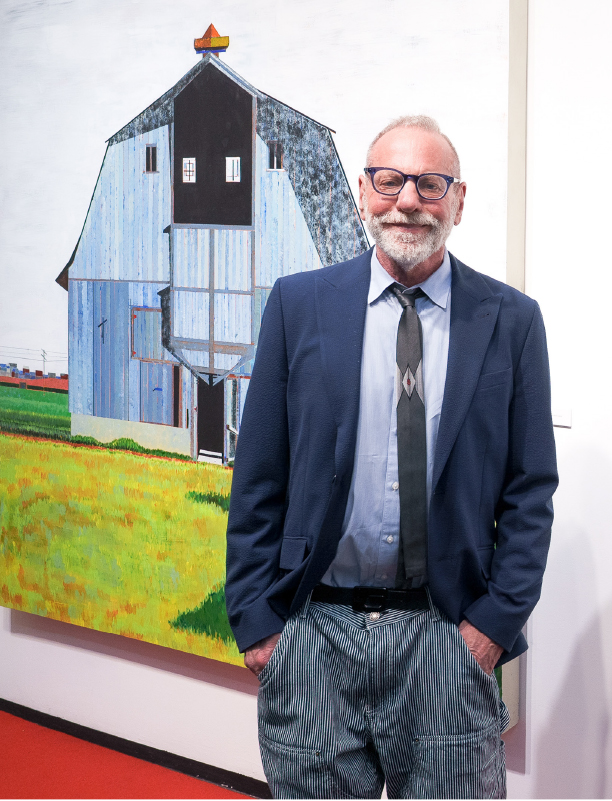
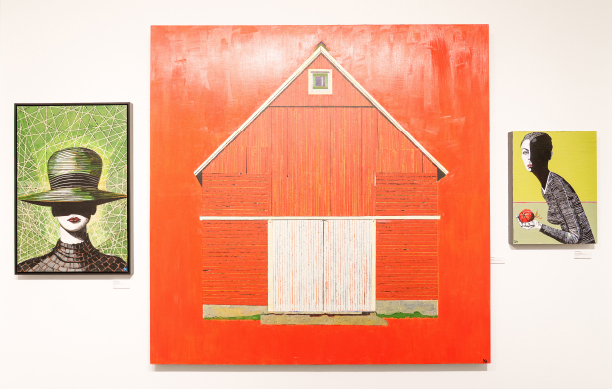
The weathered barns that began appearing in Don Hershman’s paintings several years ago seemed, at first, an unlikely turn for an artist whose work had explored the male body, sexuality, shadows and the complicated ways people present themselves to the world. Hershman painted the buildings large, sometimes monumental, emphasizing old boards, beams, faded surfaces and the marks left by years of exposure to the elements. Yet he was less interested in documenting rural architecture than in what those buildings had come to represent.
“These barns mirror our own human journey: tested by the elements, shaped by trials, yet still standing,” Hershman said of the series.
Spend time with Hershman’s work and the connection begins to make sense. The San Francisco-based artist has spent much of his career looking at what experience does to people and things. Bodies carry history. Shadows alter what we think we see. Buildings acquire scars. People learn when to reveal themselves and when to conceal themselves. Even the lines that have become increasingly prominent in his recent paintings can serve as boundaries while simultaneously holding a composition together.
This fall, those ideas converge in “= OUT OF LINE =,” Hershman’s solo exhibition at One Art Space in Tribeca, opening in October. Curated by MaryAnn Giella McCulloh, the exhibition brings together works from “The Art of Code Switching,” “I Am a Barn,” “Urban Abstraction” and “Still/Still.” Seen collectively, the paintings chart Hershman’s movement from representation toward greater abstraction and reveal the repeated line as a visual thread running through portraits, buildings, city surfaces and still lifes.
It is the latest chapter in a career that Hershman once imagined for himself as a child but did not initially pursue. Born and educated in New York, he grew up drawing, filling sketchbooks and experimenting with color. Visits to museums including the Metropolitan Museum of Art encouraged dreams of becoming an artist, but when Hershman reached the point of choosing a profession, practicality won. He studied pre-medicine and psychology at the State University of New York at Buffalo, graduating cum laude, and continued into podiatric medicine and surgical training before establishing a practice in San Francisco. His medical career would eventually include board certification and fellowships with the American Board of Podiatric Surgery and the American College of Foot and Ankle Surgery.
Painting never really left the picture. During medical school and residency, Hershman continued to draw, finding that sketching helped him comprehend the complicated spatial relationships of anatomy. There was a natural affinity between learning to see how structures fit together beneath the skin and learning how shapes, colors and lines coexist on a flat surface. Hershman was developing the precision of a surgeon at the same time he was refining the eye and hand of a painter.
His arrival in San Francisco also placed him within a community undergoing enormous change. Hershman has spoken about being a gay man entering residency in the early 1980s, when relocating to the South left him feeling that professional survival required returning to the closet. When he later settled in San Francisco, he practiced medicine as the AIDS epidemic was devastating the city. Among the young men he encountered were people concealing their sexuality and sometimes their HIV status, constantly adjusting what they disclosed according to the environment around them. Decades later, those memories would become central to one of Hershman’s most personal exhibitions.
It was also in San Francisco that Hershman shared 17 years with Victor Arimondi, the Italian American fashion model and photographer whose creative influence would become inseparable from his own story. Arimondi had appeared in Vogue, Harper’s Bazaar and Esquire and modeled for designers including Valentino and Cerruti before moving behind the camera. His photographs ranged from portraits of Grace Jones, Liv Ullmann and Norman Mailer to male nudes and images documenting people experiencing homelessness in San Francisco’s Tenderloin. When Arimondi passed away of AIDS in 2001, Hershman inherited his artistic estate and an archive of photographs that preserved both an individual creative life and a particular cultural moment.
Arimondi’s influence continued long after his passing. Hershman has described his former partner as the person who guided and molded him creatively during their years together and said that after losing him, making art increasingly felt like a necessity rather than a choice. That relationship eventually became the heart of the 2021 exhibition “Donald and Victor: Under the Influence” at Salomon Arts Gallery in New York. Hershman placed his paintings in dialogue with Arimondi’s photography, including his own painted interpretations of several photographs, allowing the exhibition to function simultaneously as retrospective, collaboration and deeply personal memorial.
By then, Hershman had been pursuing his own art publicly for decades. His professional breakthrough had arrived in an appropriately accidental way. At a party at his San Francisco home in 1992, a curator from Spectrum Gallery noticed his paintings on the walls and invited him to participate in a group exhibition. All the pieces sold. The experience encouraged Hershman to take the artistic career he had imagined as a child much more seriously.
Recognition followed gradually. Hershman’s work entered private collections and appeared in solo and group exhibitions nationally and internationally. A significant institutional milestone came when his work was jury selected for the de Young Open at San Francisco’s de Young Museum in 2020. He later received recognition at the 2022 MvVO ART/AD ART SHOW in New York, where his work was shown at the Oculus, and his paintings returned to the de Young Open in 2023. His work has since appeared at venues and events ranging from the LA Art Show to Red Dot Miami and CONTEXT Art Miami, while solo exhibitions have taken him from Provincetown and San Francisco back to New York.
As Hershman’s exhibition history expanded, the work became increasingly autobiographical. In 2022, “Sexuality and Shadows” in Provincetown used saturated color, dramatic cropping and areas of black to reconsider the male figure. Shadows had appeared in his paintings for years, but Hershman now brought them to the foreground, interested in their ability to introduce mystery and psychological complexity without overwhelming the physical beauty of the subject.
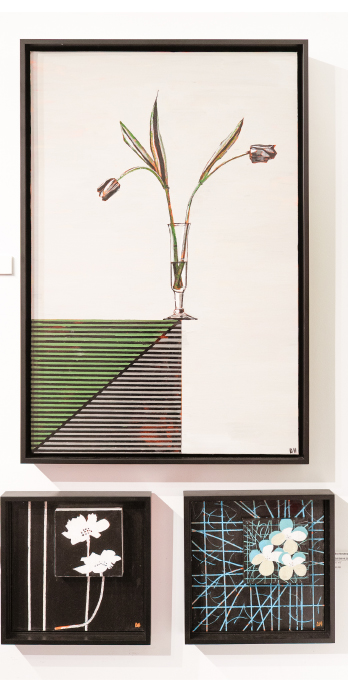
Later that year, his “Shadow Series” at Red Dot Miami expanded the idea beyond the body. Dogs, bicycles, flowers and human figures were paired with their shadows as Hershman began reconsidering darkness itself. Rather than relying on the familiar association of shadows with fear or trauma, he described the 14-painting series as an attempt to move toward healing, compassion and acceptance.
The next year brought the personal history behind those explorations even closer to the surface. “The Art of Code Switching,” a 20-painting exhibition at an Art Gallery in Tribeca, examined the social adjustments people make when navigating environments in which some aspect of their identity may not be accepted. For Hershman, the concept connected directly to his memories of medical residency and the AIDS era. Portraiture, overlapping imagery, color and shadow became ways of exploring the distance that can exist between private identity and public presentation.
That exhibition also arrived during a period of growing recognition. Hershman showed at Red Dot Miami and CONTEXT Art Miami in 2023 and continued exhibiting extensively in California. The following year included the LA Art Show and the San Francisco debut of “I AM A BARN” at Radian Gallery. In 2025 alone, his official CV records exhibitions at San Francisco City Hall, Sea Ranch Lodge, Firehouse Arts Center and MAG Galleries, along with New York’s Artifact Projects and Wessling Contemporary in San Francisco. His 2026 schedule has continued with exhibitions at the Petaluma Arts Center, Mountain View Center for the Performing Arts and other Bay Area venues.
Against that backdrop, the barns become less of a departure than they initially appeared. Hershman was still painting portraits, only the subjects had changed. The cracked wood and bowed structures of “I Am a Barn” allowed him to explore endurance without depicting a human figure. Their surfaces recorded time much as a face or body might. Their beams and weathered boards also introduced a stronger linear quality into his compositions, providing the bridge to what followed.
“Urban Abstraction” took that language back into the city. Cropped portions of garage doors, pavement, graffiti and walls became compositions built from pattern, interruption and color. “Still/Still” brought the same increasingly meditative eye to everyday objects. The progression from barns to streets to still lifes gradually loosened Hershman’s relationship with literal representation while preserving the structural discipline that has characterized his work from the beginning.
That evolution is what gives “= OUT OF LINE =” its significance. Rather than presenting another discrete Hershman series, the Tribeca exhibition offers an opportunity to look across them and recognize how closely connected they have always been. The anatomical precision developed during medical training, Arimondi’s photographic influence, the darkness and light of the shadow paintings, the fractured identities of “Code Switching,” the scarred surfaces of the barns and the repeated markings of his urban abstractions all belong to a continuing investigation of how experience changes what we see.
There is also something fitting about that story returning to New York. The city where Hershman first wandered museums imagining an artistic life has become the setting for some of the most personal exhibitions of the career he eventually built. Medicine may have provided the secure path he chose as a young man, but art remained alongside it, gathering the experiences of a life that did not unfold in a straight line.
Now those experiences are increasingly visible in the lines themselves. In Hershman’s paintings, they can describe a body, support a barn, divide a city wall or dissolve into abstraction. After more than three decades of exhibiting his work, Hershman seems less concerned with staying inside any particular category than with discovering where the next line might take him.
For more information, please visit: www.donhershman.com
Photos: BFA / Victor Arriola